
5. 函数传值与深拷贝、浅拷贝
我们在对象与对象直接协作时,一个对象常需要获得另一个对象的私有成员变量。那么另外的那个对象就需要定义一个 Getter 函数,但是需要注意的是,对于返回成员对象和数组类型的 Getter 函数,我们通常是不能也不建议直接返回成员变量的,因为这样会破坏类对象的封装性。
首先,我们需要了解在Java中哪些数据类型在函数传值的过程中是传递对象地址。
5.1. Java中的“传值”和“传引用”问题
- 对于 Java 函数中的参数究竟是“传值”还是“传引用”,有以下两点定论:
在Java中,当 基本类型 作为参数传入方法时,无论该参数在方法内怎样被改变,外部的变量原型总是不变的,这就叫做“值传递”,即方法操作的是参数变量(也就是原型变量的一个值的拷贝)改变的也只是原型变量的一个拷贝而已,而非变量本身。所以变量原型并不会随之改变。
当方法传入的参数为非基本类型时(也就是说是一个对象类型的变量), 方法里面改变参数变量的同时变量原型也会随之改变。这种特性就叫做“引用传递”,也叫做 传址,即方法操作参数变量时是拷贝了变量的引用。
1 2 3 4 5 6 7 8 9 10 11 12 13 14 15 16 17 18 19 20 21 22 23 24 25 26 27 28 29 30 31 32 33 | public class ValueMain { public static void main(String[] args) { int number=10; int num=count(number); System.out.printf("num is %d%n", num); System.out.printf("number is %d%n", number); //这里的%n是换行的格式字符串 String message="message"; String message2=concat(message); System.out.println(message); System.out.println(message2); } public static int count(int number){ for (int i=0;i<10;i++){ number++; } return number; } /** code running result : * num is 20 * number is 10 */ public static String concat(String message){ message+=" concat "; return message; } /** code running result : * message * message concat */ } |
有人看到上面代码运行结果可能会有疑问,String 字符串对象为什么也可以实现 “值传递” ?其实这和 Java String 类的实现方式有关, 点击查看 String 的定义 或通过 JDK 文档查看 String 的定义,我们会发现 String 类对象的值是存储在 char 类型数组中的,而且这个数组和类是由 final 修饰的,也就是说, 字符串一旦定义则不可变。
5.1.1. Java 中将实参传递给方法(或函数)的方式是值传递 1
如果有学过C++,那么肯定觉得 Java 对引用类型的参数采用的是引用传递。实际上,并不是的,这里传递的还是值,不过,这个值是实参的地址罢了!
- 程序设计语言将实参传递给方法(或函数)的方式分为两种:
值传递 :方法接收的是实参值的拷贝,会创建副本。
引用传递 :方法接收的直接是实参所引用的对象在堆中的地址,不会创建副本,对形参的修改将影响到实参。 很多程序设计语言(比如 C++、 Pascal )提供了两种参数传递的方式,不过,在 Java 中只有值传递。
1 2 3 4 5 6 7 8 9 10 11 12 13 14 15 16 17 18 19 20 21 22 23 24 25 26 27 28 29 30 31 32 | public static void main(String[] args) { Department department1=new Department(1244,"1244"); Department department2=new Department(2399,"2399"); swap(department1,department2); System.out.println("--------original after swap-------"); swapPrinter(department1,department2); String message1="message1"; String message2="message2"; swap(message1,message2); System.out.println("--------original after swap-------"); swapPrinter(message1,message2); int i1=12; int i2=13; swap(i1,i2); System.out.println("--------original after swap-------"); swapPrinter(i1,i2); } public static <T> void swap(T first,T second){ System.out.println("-----execute swap function----"); T temp=first; first=second; second=temp; swapPrinter(first,second); } public static <T> void swapPrinter(T first, T second){ System.out.println("first object is: "+first); System.out.println("second object is: "+second); } |
-----execute swap function----
first object is: Department{id=2399, name='2399'}
second object is: Department{id=1244, name='1244'}
--------original after swap-------
first object is: Department{id=1244, name='1244'}
second object is: Department{id=2399, name='2399'}
-----execute swap function----
first object is: message2
second object is: message1
--------original after swap-------
first object is: message1
second object is: message2
-----execute swap function----
first object is: 13
second object is: 12
--------original after swap-------
first object is: 12
second object is: 13
- Java 中将实参传递给方法(或函数)的方式是值传递 :
简单来说,如果参数是基本类型的话,很简单,传递的就是基本类型的字面量值的拷贝,会创建副本。 如果参数是引用类型,传递的就是实参所引用的对象在堆中地址值的拷贝,同样也会创建副本。
备注
理解这些需要了解 Java 的栈和堆。JVM里的堆(heap)特指用于存放Java对象的内存区域。所以根据这个定义,Java对象全部都在堆上。而栈中保存的是基本类型或自定义对象的引用(地址),而自定义对象的引用则指向堆。Java 中传递给方法(或函数)的实参是将拷贝后的栈中的值。
5.2. 通过实现 Cloneable 接口进行拷贝 2
简单来说,在Java中,拷贝就是创建一个和已知对象一模一样的对象,而拷贝有深拷贝和浅拷贝之分。
Java 将内存空间分为堆和栈。基本类型直接在栈中存储数值,而引用类型是将引用放在栈中,实际存储的值是放在堆中,通过栈中的引用指向堆中存放的数据。
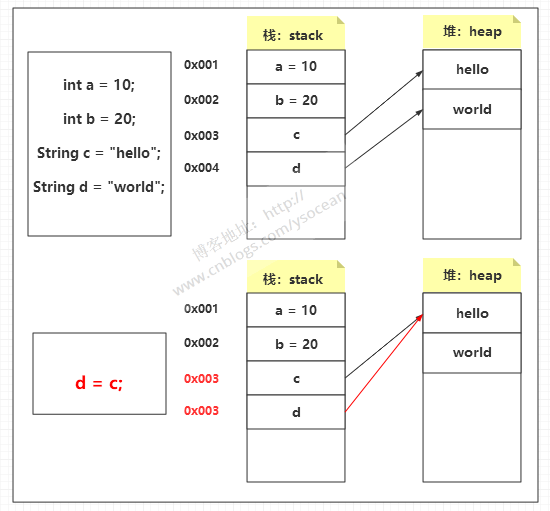
图 5.2.1 clone
5.2.1. 浅拷贝
- 浅拷贝
创建一个新对象,然后将当前对象的非静态字段复制到该新对象,如果字段是值类型(即是 Java 基本类型或 String 类型的)的,那么对该字段执行复制;如果该字段是引用类型的话,则复制引用但不复制引用的对象,原始对象及其副本引用同一个对象。
备注
浅拷贝之所以称之为浅拷贝,那便是他不能彻底拷贝一个对象。通过浅拷贝获得的拷贝对象的存储仍然与源对象的存储有交叉。参考下文中的 浅拷贝示例 。
1 2 3 4 5 6 7 8 9 10 11 12 13 14 15 16 17 18 19 20 21 22 23 24 25 26 | public class implements Cloneable{ private int id; private String name; public Department(int id, String name) { this.id = id; this.name = name; } @Override protected Object clone() throws CloneNotSupportedException { return super.clone(); } @Override public String toString() { return "Department{" + "id=" + id + ", name='" + name + '\'' + '}'; } //Getters and Setters } |
1 2 3 4 5 6 7 8 9 10 11 12 13 14 15 16 17 18 19 | public class Employee implements Cloneable{ private int empoyeeId; private String employeeName; private Department department; public Employee(int id, String name, Department dept) { this.empoyeeId = id; this.employeeName = name; this.department = dept; } @Override protected Object clone() throws CloneNotSupportedException { return super.clone(); } //Getters and Setters } |
1 2 3 4 5 6 7 8 9 10 11 12 | public static void main(String[] args) throws CloneNotSupportedException { Department hr = new Department(1, "Human Resource"); Employee original = new Employee(1, "Admin", hr); Employee cloned = (Employee) original.clone(); //Let change the department name in cloned object and we will verify in original object cloned.getDepartment().setName("Finance"); System.out.println(original.getDepartment().getName()); //Finance System.out.println(cloned.getDepartment().getName()); //Finance } |
需要注意的是,一些对象(该对象的属性都是基本类型或String)的浅拷贝的表现类似于深拷贝。
1 2 3 4 5 6 7 8 9 10 | public static void main(String[] args) throws CloneNotSupportedException { Department hr = new Department(1, "Human Resource"); Department department= (Department) hr.clone(); department.setId(1244); department.setName("1244"); System.out.println(hr); //Department{id=1, name='Human Resource'} System.out.println(department); //Department{id=1244, name='1244'} } |
5.2.2. 深拷贝
- 深拷贝
创建一个新对象,然后将当前对象的非静态字段复制到该新对象,无论该字段是值类型的还是引用类型,都复制独立的一份。当你修改其中一个对象的任何内容时,都不会影响另一个对象的内容。
深拷贝示例依旧使用拷贝示例类 Employee 和 Department ;唯一区别在于 Employee 类的 clone 方法需要重写成以下形式:
1 2 3 4 5 6 | @Override protected Object clone() throws CloneNotSupportedException { Employee cloned = (Employee)super.clone(); cloned.setDepartment((Department)cloned.getDepartment().clone()); return cloned; } |
1 2 3 4 5 6 7 8 9 10 | public static void main(String[] args) throws CloneNotSupportedException { Department hr = new Department(1, "Human Resource"); Department department= (Department) hr.clone(); department.setId(1244); department.setName("1244"); System.out.println(hr); //Department{id=1, name='Human Resource'} System.out.println(department); //Department{id=1244, name='1244'} } |
1 2 3 4 5 6 7 8 9 10 11 12 | public static void main(String[] args) throws CloneNotSupportedException { Department hr = new Department(1, "Human Resource"); Employee original = new Employee(1, "Admin", hr); Employee cloned = (Employee) original.clone(); //Let change the department name in cloned object and we will verify in original object cloned.getDepartment().setName("Finance"); System.out.println(original.getDepartment().getName()); //Human Resource System.out.println(cloned.getDepartment().getName()); //Finance } |
这种做法有个弊端,这里我们 Employee 类只有一个 Department 引用类型,而 Department 类没有,所以我们只用重写 Department 类的 clone 方法,但是如果 Department 类也存在一个引用类型,那么我们也要重写其 clone 方法,这样下去,有多少个引用类型,我们就要重写多少次,如果存在很多引用类型,那么代码量显然会很大,所以这种方法不太合适对已有代码进行修改。
5.3. 通过实现 Serializable 接口进行深拷贝
序列化是将对象写到流中便于传输,而反序列化则是把对象从流中读取出来。这里写到流中的对象则是原始对象的一个拷贝,因为原始对象还存在 JVM 中,所以我们可以利用对象的序列化产生克隆对象,然后通过反序列化获取这个对象。
通过实现 Serializable 接口进行拷贝 ,即通过序列化实现拷贝,通过序列化实现的拷贝一定是深拷贝。因为序列化产生的是两个完全独立的对象,所有无论嵌套多少个引用类型,序列化都是能实现深拷贝的。
- 实现序列化的方法
- 实现Serializable接口
该接口是一个可序列化的标志,并没有包含实际的属性和方法。
如果不在该方法中添加readObject()和writeObject()方法,则采取默认的序列化机制。如果添加了这两个方法之后还想利用Java默认的序列化机制,则在这两个方法中分别调用defaultReadObject()和defaultWriteObject()两个方法。
为了保证安全性,可以使用transient关键字进行修饰不必序列化的属性。因为在反序列化时,private修饰的属性也能被查看到。
- 实现ExternalSerializeable方法
自己对要序列化的内容进行控制,控制哪些属性能被序列化,哪些不能被序列化。
1 2 3 4 5 6 7 8 9 10 11 12 13 | public class Department implements Serializable { private int id; private String name; public Department(int id, String name) { this.id = id; this.name = name; } //Getters and Setters and toString } |
1 2 3 4 5 6 7 8 9 10 11 12 13 14 15 | public class Employee implements Serializable { private int empoyeeId; private String employeeName; private Department department; public Employee(int id, String name, Department dept) { this.empoyeeId = id; this.employeeName = name; this.department = dept; } //Getters and Setters and toString } |
1 2 3 4 5 6 7 8 9 10 11 12 13 14 15 16 17 18 19 20 21 22 23 24 25 26 27 28 29 30 31 | public class DeepCopyMain { public static void main(String[] args) throws Exception { Department hr = new Department(1, "Human Resource"); Employee original = new Employee(1, "Admin", hr); Employee cloned = deepClone(original); cloned.getDepartment().setName("Finance"); System.out.println(original); //Employee{empoyeeId=1, employeeName='Admin', department=Department{id=1, name='Human Resource'}} System.out.println(cloned); //Employee{empoyeeId=1, employeeName='Admin', department=Department{id=1, name='Finance'}} } //深度拷贝 public static <T extends Serializable> T deepClone(T origin) throws Exception{ // 序列化 ByteArrayOutputStream bos = new ByteArrayOutputStream(); ObjectOutputStream oos = new ObjectOutputStream(bos); oos.writeObject(origin); // 反序列化 ByteArrayInputStream bis = new ByteArrayInputStream(bos.toByteArray()); ObjectInputStream ois = new ObjectInputStream(bis); //需要处理类型变换异常 T object = (T) ois.readObject(); return object; } } |
- 1
引用自 JavaGuide 文章: 为什么 Java 只有值传递?
- 2
引用自 博客园 文章: Java的深拷贝和浅拷贝